Best Mini PC for a Local Coding Agent in 2026 — Why Prefill, Not Tokens/Sec, Decides Your Box
A coding agent re-sends your whole repo context every single turn, which makes it a prefill-bound workload. That flips the buying logic: ~1,700 tok/s prompt processing on a GB10 box vs ~340 tok/s on Strix Halo, while generation is a near-tie. Here's the per-budget verdict, the memory math, and the boxes to skip — with the caveat that NVIDIA's October repricing has widened the price gap to about $3,500.
DataHardware Team
Our Top Pick
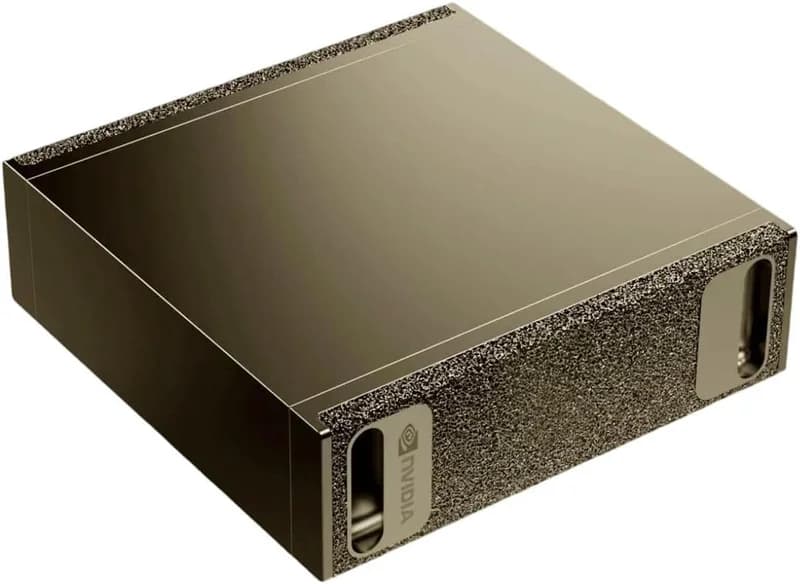
NVIDIA DGX Spark (GB10 Grace Blackwell)
$6,950Quick answer: buy for prompt-processing throughput, not tokens/sec — a coding agent is a prefill-bound workload. Every turn of an agent loop re-sends the whole context (system prompt, open files, diffs, tool output), so the machine re-reads tens of thousands of tokens before it writes a single character. That is why the two dominant 128GB platforms diverge so sharply on this job: on gpt-oss 120B, prompt processing runs at roughly 1,723 tok/s on a GB10 box versus roughly 340 tok/s on a Strix Halo box (hardware-corner.net), while token generation is a near-tie at about 38 vs 34 tok/s (Micheal Lanham, Medium, 2026). In wall-clock terms, a 60,000-token repo context is about 35 seconds of waiting on GB10 and about three minutes on Strix Halo — every turn. The picks: NVIDIA DGX Spark ($6,950) if the agent loop is your job and the wait is intolerable; Framework Desktop ($3,449) if you want the cheapest 128GB box and can live with the ingest; Mac Studio M4 Max ($2,499+ final, now discontinued) if you want silence and macOS. Note that NVIDIA's October repricing has widened the Strix Halo discount to roughly $3,500 against the Spark, or about $2,550 against the GB10-based ASUS Ascent GX10 at its 1TB tier.
Why a coding agent is a different workload than a chatbot
Almost every "best mini PC for local AI" guide — including, until now, most of ours — frames the buying decision around one question: will the model fit? Can this box hold a 70B at 4-bit, can it hold gpt-oss 120B. That framing is correct for a chatbot. It is the wrong framing for an agent, and the difference is structural rather than cosmetic.
Here is the agentic loop, stripped down:
- You give the agent a task. It reads three files to orient itself.
- Those file contents go into the context. The agent calls a tool — a grep, a test run, a build.
- The tool output goes into the context. The agent proposes an edit.
- The edit result goes into the context. Repeat, ten to forty times, for one task.
The critical property is this: the model is stateless between turns, so the entire accumulated context is re-submitted and re-processed on every single turn. Turn 12 does not resume from turn 11's state — it re-reads everything from turn 1 forward, plus the new tool output. A repo context that settles at 60,000 tokens is not a one-time 60,000-token cost. It is a 60,000-token cost paid dozens of times per task.
Contrast that with a chat session. You type 40 tokens, the model writes 800. The prompt is trivially short, so prompt processing is instant and the experience is entirely governed by generation speed — the tokens/sec number every spec sheet leads with. Chat is generation-dominated. Agents are ingest-dominated.
"A local coding agent is a prefill-bound workload, not a generation-bound one: because each turn re-sends the whole file context, prompt-processing throughput — roughly 1,700 tok/s on a GB10 box versus roughly 340 tok/s on a Strix Halo box — determines whether the agent feels usable, even though the two platforms generate tokens at nearly the same speed."
— DataHardware editorial desk, extending the benchmark set in our Strix Halo prefill analysis
This is why developers who bought a 128GB box on a tokens/sec comparison and then pointed Cline at it report the machine "feels broken" even though the benchmark numbers were accurate. The benchmark measured generation. The agent is bottlenecked on ingest. Both facts are true at once.
The number that actually matters — prefill throughput
Prompt processing — prefill — is the phase where the model reads your input and builds the KV cache before generating anything. It is highly parallel matrix math across the whole prompt at once, so it is compute-bound: it wants raw FLOPs. Generation (decode) re-reads weights one token at a time and is bandwidth-bound. Those are opposite appetites, and the current crop of unified-memory boxes satisfies them very unevenly.
The arithmetic you need is one line:
time-to-first-token ≈ context_tokens ÷ prefill_tok_s
Work it at a realistic agent context of 60,000 tokens — three or four source files, a test log, a system prompt, and the accumulated tool output of a mid-length session:
| Platform | Prefill (gpt-oss 120B) | Wait on a 60k-token turn | Generation |
|---|---|---|---|
| GB10 Grace Blackwell (DGX Spark, Ascent GX10) | ~1,723 tok/s | ~35 seconds | ~38 tok/s |
| Strix Halo (Ryzen AI Max+ 395) | ~340 tok/s | ~2 min 56 s | ~34 tok/s |
| Gap | ~5× | ~5× | near tie |
Sources and caveats: the ~1,723 vs ~340 tok/s prefill split comes from hardware-corner.net's "First DGX Spark LLM Benchmarks" on gpt-oss 120B, corroborated by owner writeups at yuv.ai and vettedconsumer.com and reproduced in our own prefill post. The ~38 vs ~34 tok/s generation figures are from Micheal Lanham's 2026 Medium piece "A $1,500 Box Generates as Fast as the $4,699 DGX Spark. Then the Agent Hits Prefill," which reaches the same conclusion from an independent agent-workload angle. The wall-clock numbers above are division, not measurement. Treat "roughly 5× on this model" as the takeaway; prefill throughput is hardware-, quant- and prompt-dependent, and hardware-corner also found that real document text prefills 24–33% slower than synthetic benchmark prompts — so real source code likely lands worse than the table, not better.
What prompt caching does and does not fix
The obvious objection: doesn't KV-cache reuse solve this? Partly. llama.cpp and most serving stacks will reuse the cached prefix when the beginning of your prompt is byte-identical to the previous turn, so an agent that only appends tool output pays for the new tokens rather than the whole context. When it works, it is the single biggest quality-of-life improvement available.
The trouble is that agents invalidate prefixes constantly. Editing a file that appears early in the context, re-ordering the file list, injecting a fresh timestamp into the system prompt, or trimming the context window all shift the byte offsets and force a full re-ingest. In practice you get a mix: many cheap turns and periodic expensive ones, with the expensive ones landing unpredictably. Caching moves the average down; it does not change the ceiling. Buy for the uncached case.
How much memory a local coding agent actually needs
Model choice for this workload has consolidated around sparse mixture-of-experts coders — high total parameter counts for quality, low active counts so generation stays fast on a bandwidth-limited box. Qwen3-Coder-Next (80B total / 3B active, 256K native context) is the current default for agent work, with the smaller Qwen3.5-35B-A3B as the option for people who want headroom for everything else on the machine.
Per Unsloth's published quantization tables, the 4-bit footprints land roughly at:
| Model class | 4-bit weights | Realistic total with agent KV cache | Minimum box |
|---|---|---|---|
| ~27B–35B dense / 35B-A3B MoE | ~22GB | ~40–50GB | 64GB |
| 80B-A3B class (Qwen3-Coder-Next) | ~45–50GB | ~70–85GB | 128GB |
| 122B-A10B class | ~70GB | ~95GB+ | 128GB |
The trap is the second column. Sizing tools and vendor pages quote weight footprints, and a 64GB box "fits" a 22GB model with what looks like enormous headroom. Then you run an agent at a 128K–256K context window and discover that the KV cache is a large, growing second allocation that scales with context length, not with model size. That is precisely the failure mode behind "it worked for an hour and then the machine started swapping" — the model always fit; the session didn't.
Two practical consequences. First, run the numbers before you buy: our VRAM calculator sizes weights and KV cache together, which is the only comparison that matters here. Second, on a Strix Halo box you must actually assign the memory — up to 96GB is GPU-allocatable, but the default BIOS split is far lower. Our Strix Halo VRAM allocation guide walks the BIOS and GTT settings; skipping it is the most common reason a correctly-specced box underperforms.
One more note on quantization: for prefill-heavy work, keep the KV cache at f16 rather than q4/q8. Quantized KV saves memory and speeds generation, but per hardware-corner's optimization testing it slows prompt ingestion — the opposite of what an agent needs. On 128GB you can afford the f16 cache.
The four boxes, ranked for this workload
Every price below comes from our catalog and is a date-stamped seed rather than a live quote. The 128GB Strix Halo and GB10 boxes were re-verified 2026-08-30 and repriced sharply between our June and August checks; the Apple and sub-$600 entries still carry their 2026-06-29 check. This category repriced hard during the 2026 DRAM shortage, as we documented in August. Verify at checkout.
Fastest agent loop, CUDA-native: NVIDIA DGX Spark / ASUS Ascent GX10
The NVIDIA DGX Spark ($6,950) and the ASUS Ascent GX10 ($5,999 – $7,999) both run the GB10 Grace Blackwell superchip: a 20-core Arm CPU, a Blackwell GPU with 5th-gen tensor cores, 128GB of coherent unified memory at 273 GB/s, and ConnectX-7 200GbE for two-unit clustering. The tensor cores are what deliver the ~5× prefill advantage, and being CUDA-native means vLLM, TensorRT-LLM and every Blackwell-optimized serving stack run without a porting adventure.
Best for: a developer whose primary daily workload is the agent loop, especially at long contexts, and who has already decided the wait is the problem. This is the only tier where the premium buys something an agent user feels on every turn. The ordering inside the platform has flipped twice: the GX10 was the value play, then by September its $5,999 entry price (1TB, sold by Amazon, 2026-09-29) sat above the Spark's $4,699 list price, and NVIDIA's 2026-10-02 repricing of the 128GB Spark to $6,950 put the GX10 back in front. On list price the GX10 is now the cheaper way into GB10. Platform background lives in our GB10 hub.
Against it: NVIDIA raised the official price from $3,999 to $4,699 in February 2026 citing memory supply, then to $6,950 for the 128GB model on 2026-10-02, and stock is thin. 273 GB/s is unremarkable bandwidth for the money — you are not buying generation speed.
Best value 128GB: Framework Desktop
The Framework Desktop at $3,449 is the cheapest verified 128GB box in our catalog, and for agent work the argument is blunt: it generates tokens at essentially the same speed as a machine costing about $3,500 more, and you pay for that in ingest wait. Ryzen AI Max+ 395, Radeon 8060S (40 CU), 128GB LPDDR5X-8000 with up to 96GB allocatable, on a standard mini-ITX mainboard with open firmware — the best Linux story in the category, which matters because you will be compiling llama.cpp with ROCm flags.
Best for: a developer whose agent sessions run at moderate context (10k–30k tokens), or who is happy to fire off a task and come back. At $3,449 the payback math (below) is slower than it was a year ago but still closes inside two years. The GMKtec EVO-X2 is the same silicon in a more polished chassis at $3,649 — only $200 more, so that one comes down to chassis and warranty preference rather than value — see the head-to-head.
Best team box: Beelink GTR9 Pro / Minisforum MS-S1 Max
If the box is going to serve a 2–10 person team rather than one desk, network IO stops being a footnote. The Beelink GTR9 Pro ($4,349) brings dual 10GbE and dual USB4 with vapor-chamber cooling that holds sustained inference at 125–128W and 39–41 dBA (ServeTheHome). The Minisforum MS-S1 Max ($3,879) goes further — dual 10GbE, dual USB4 v2 at 80Gbps, a PCIe x16 slot, a 320W internal PSU and a 2U rack option — which makes it the pick if you want the option to bolt on a discrete GPU later specifically to accelerate prefill.
Best for: a shared endpoint on the LAN that several developers point their agents at. Serving concurrently multiplies the ingest problem, so a fast link to the box and headroom in cooling both earn their keep. Caveat on the GTR9 Pro: there are reported 10GbE NIC instability and BSOD issues under heavy GPU load — driver-dependent, and worth checking current firmware before you commit a team to it. And a pricing caveat: at $4,349 the GTR9 Pro is the dearest consumer Strix Halo box in the catalog, so its dual 10GbE has to be worth roughly $900 over the Framework to you. For a business buyer who wants a warranty and vPro manageability, the HP Z2 Mini G1a ($5,349 – $7,406) is the same platform with a support contract — but it now costs a thousand dollars more again, so the manageability has to be worth it. All of this tier is covered in the Strix Halo hub.
Quietest, macOS-native: Mac Studio M4 Max
The Mac Studio M4 Max ($2,499+ at its final pricing, discontinued in September 2026 and replaced by an M5 Max Studio from the same $2,499) reaches up to 128GB of unified memory at 410–546 GB/s — genuinely higher real bandwidth than any Strix Halo or GB10 box — in a silent desktop that runs MLX and llama.cpp natively. If your team already lives in macOS and the machine sits on a desk in a quiet office, this is a real answer — and a more competitive one than it used to be, since the DRAM spike hit the x86 boxes much harder than it hit Apple's pricing. The Mac Mini M4 Pro ($1,599 final, discontinued, 24–64GB at 273 GB/s) was the entry rung and handles a 27B–35B coder well for single-file work.
The honest caveat: Apple's bandwidth advantage accelerates generation, not prompt processing. Apple silicon is not a prefill monster either, and buying a Mac Studio expecting it to fix time-to-first-token is a misread of what the 546 GB/s number describes. Buy it for silence, build ergonomics and macOS integration. Note also that the M3 Ultra's 256GB and 512GB configs were pulled during the DRAM shortage — see the M4 Max vs M3 Ultra comparison and the Apple Silicon hub.
Explicitly do not buy these for a coding agent
The credibility of a "buy this" list is set by whether the author is willing to publish a "don't":
- Mac Mini M4 ($799 final, discontinued) — 16–24GB at 120 GB/s. Excellent little computer, wrong tool. No room for an agent-grade model plus a long-context cache, and the lowest bandwidth in the lineup.
- Beelink SER8 ($799 – $939) — 32GB DDR5-5600 ceiling. Fine as an always-on host for small models; it cannot hold an agent session.
- GMKtec M6 Ultra ($629) — 32GB, 7B–13B territory. Same verdict.
- MAGICNUC AS1 ($329) — not in this conversation at all.
These are all legitimate purchases for other jobs — a home server, a media box, an always-on host for a small classifier. None of them will run a coding agent over a real repository, and no amount of quantization changes that. If your budget is genuinely under $1,000, the correct move is to keep using a cloud model rather than buy a box that will disappoint you.
One to watch rather than buy: Zotac has announced a Strix Halo box but it has not shipped and is not in our catalog, so we are not quoting specs or a price for it. If it lands meaningfully under $3,449 it changes the value tier.
Wiring Claude Code and Cline to your own box
The setup is less involved than people expect, because every serious agent front-end talks OpenAI-compatible HTTP.
- Serve the model on the box. llama.cpp's
llama-server, LM Studio's server mode, or Ollama all expose an OpenAI-compatible endpoint. Bind it to the LAN interface, not localhost, if the agent runs on a different machine. - Load an agent-grade coder in GGUF at 4-bit, with the context window set to what your sessions actually reach and the KV cache left at f16.
- Point the agent at it via its base-URL and model-name environment variables. Cline and Continue expose this in settings directly; Claude Code and Kilo read it from the environment. Check your version's docs for the exact variable names — they move between releases.
- Run the agent on your laptop and the model on the box. The agent process is lightweight; only inference needs the hardware.
The one tuning decision that matters here: on Strix Halo, the llama.cpp backend choice is not a wash. Per soothill.io's August 2026 "llama.cpp: Vulkan vs ROCm on Strix Halo" testing, ROCm substantially outperforms Vulkan on prompt processing while Vulkan can win on generation — which is exactly backwards from what most people default to, because Vulkan is the easier install. For an agent workload, prompt processing is the bottleneck, so take the harder ROCm path and build with ROCWMMA and Flash Attention enabled. This single choice is worth more to agent responsiveness than any model swap.
What you actually save, and when the box pays for itself
Here is the honest version, with the assumption stated inline rather than buried.
Assume $150/month of API spend — a plausible figure for a developer running an agent daily, though it is an assumption for the sake of a worked example, not a measured result. Against a $3,449 Framework Desktop, hardware alone breaks even at roughly 23 months — it was closer to 13 months before the DRAM spike, and that repricing is the single biggest change to this calculation in 2026. Electricity is a real line item on an always-on inference box and pushes that out; our power consumption analysis has the per-kWh math for this class of machine. Against a $6,950 DGX Spark, the same $150/month assumption puts break-even at nearly four years — which is why the Spark's case has to rest on prefill latency or on a confidentiality requirement, not on cost savings.
Two things that legitimately change the arithmetic:
- Team usage. One box serving four developers at $150/month each pays for itself in under six months. This is the strongest version of the argument, and it is why the dual-10GbE boxes belong in the conversation.
- Air-gap requirements. If your contract forbids sending source to a third party, payback is not the frame at all — the local box is the only compliant option and the comparison is against not having an agent.
And the thing that argues against: local coding models are meaningfully weaker than frontier models on hard problems. Community consensus puts the best current open coders around Sonnet-class on ordinary refactors and test generation, with a visible drop on multi-file architectural work and subtle debugging. That is more than good enough for the high-volume, low-stakes majority of agent turns — which is exactly where the API bill accumulates — but if you replace your cloud subscription entirely and then spend two hours on a problem a frontier model would have solved in ten minutes, you have not saved money. Budget for a hybrid.
Verdict — buy this one
| Your situation | Buy | Price | Why |
|---|---|---|---|
| The agent loop is your job; long contexts; wait is intolerable | NVIDIA DGX Spark | $6,950 | ~5× prefill; CUDA-native stack |
| Want GB10 but the Spark is out of stock | ASUS Ascent GX10 | $5,999 – $7,999 | Same GB10 silicon, better availability, 4TB SSD tier — but now well pricier than the Spark |
| Solo dev, moderate contexts, best value 128GB | Framework Desktop | $3,449 | Cheapest verified 128GB; best Linux/ROCm story |
| Shared team endpoint on the LAN | Beelink GTR9 Pro | $4,349 | Dual 10GbE, quiet sustained load |
| Team box with expansion headroom | Minisforum MS-S1 Max | $3,879 | PCIe x16 for a prefill-accelerating dGPU later |
| macOS shop, silence matters | Mac Studio M4 Max | $2,499+ (discontinued) | Up to 128GB at 410–546 GB/s, silent — replaced by an M5 Max Studio |
| Budget under $1,000 | Nothing here | — | Keep using a cloud model |
If you are still deciding between the two 128GB platforms rather than between price brackets, the underlying platform argument is laid out in DGX Spark vs Strix Halo and the direct DGX Spark vs EVO-X2 comparison. For the general-purpose version of this guide — the one that asks "will the model fit" rather than "will the agent feel fast" — see the best mini PC for local LLMs, and for model selection our 128GB model guide (note that it predates the current Qwen3.5 and Qwen3-Coder-Next releases and is due a refresh).
The summary, one more time, because it is the sentence that should change your shortlist: a coding agent is prefill-bound, so buy prompt-processing throughput and enough memory for the KV cache — not the tokens/sec number on the box.