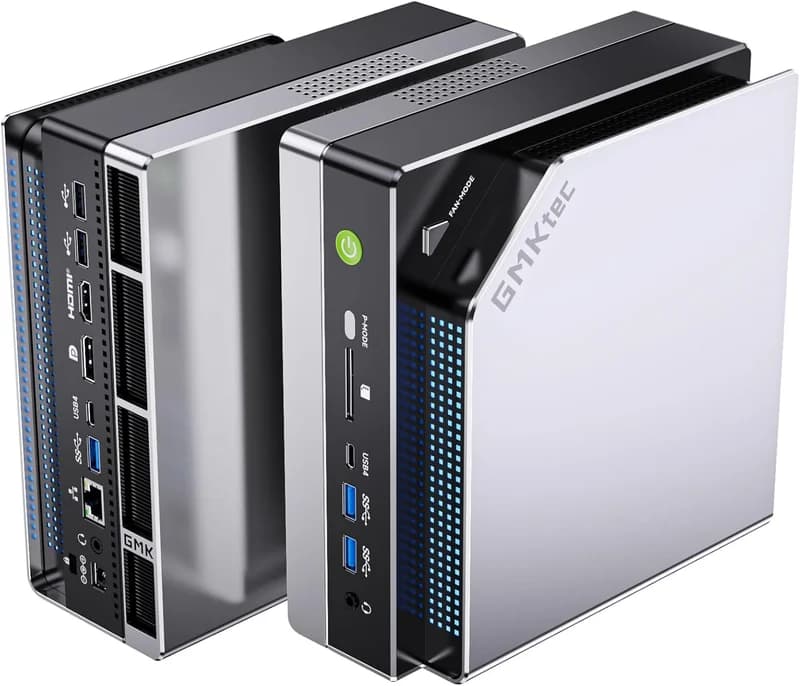
GMKtec EVO-X2 (Ryzen AI Max+ 395, 128GB)
$3,649
The flagship local-AI mini PC. AMD's Ryzen AI Max+ 395 'Strix Halo' pairs a 16-core Zen 5 CPU with a Radeon 8060S iGPU and 128GB of LPDDR5X-8000 unified memory — up to 96GB assignable as VRAM, enough to load 70B-class models that won't fit on any consumer GPU. The catch is bandwidth: ~215 GB/s real, so dense 70B runs at single-digit tokens/sec. Buy it for capacity, not raw speed.
Affiliate links — We earn a commission on qualifying purchases at no cost to you.
Specifications
| APU | AMD Ryzen AI Max+ 395 (16C/32T, Zen 5) |
| GPU | Radeon 8060S (40 CU, RDNA 3.5) |
| NPU | 50 TOPS (XDNA 2) |
| Unified Memory | 128GB LPDDR5X-8000 (up to 96GB GPU-allocatable) |
| Memory Bandwidth | 256 GB/s theoretical (~215 GB/s real) |
| Storage | 2TB NVMe (dual M.2 2280, up to 16TB) |
| Networking | 2.5GbE, Wi-Fi 7 |
| I/O | 2× USB4, HDMI 2.1, DP 1.4 |
Pros
- 128GB unified memory (96GB allocatable) loads 70B-class models no 24–32GB dGPU can hold
- 256-bit LPDDR5X-8000 is ~2× a normal desktop APU — the reason it produces usable tokens/sec
- Quiet, cool, dual-M.2 expandable — a practical always-on local inference appliance
Cons
- ~215 GB/s is far below a discrete GPU (800–1000 GB/s) — dense 70B is single-digit tok/s
- Memory is soldered — you must buy the 128GB SKU up front; no upgrade path
- 2.5GbE only (no 10GbE/OCuLink); ROCm/Linux GPU-compute on Strix Halo still rough vs CUDA
Related Articles
How Much Context Can a 128GB Mini PC Actually Hold? The KV Cache Math Nobody Runs Before Buying
Everyone sizes a unified-memory box against model weights. Almost nobody sizes it against the KV cache — and on a 128K-token agent run, the cache is the number that decides whether the job finishes. Here's the math, box by box, plus the KV-quantization trade that makes long first prompts slower, not faster.
192GB vs 128GB Unified Memory: What the Extra 64GB Actually Buys You
IFA 2026 filled the feeds with 192GB Gorgon Halo mini PCs. Capacity went up 50%; bandwidth went up about 7%. That asymmetry decides the whole purchase — here is the model-by-model list of what only 192GB runs, and why most buyers should still buy 128GB today.
How Much Unified Memory Do You Actually Need for Local AI? (64GB vs 96GB vs 128GB, 2026)
Unified memory on these boxes is soldered — it is the one spec you cannot change after checkout. Here is what each capacity tier actually runs, what the 64GB tier costs you in usable GPU memory, and why the extra 64GB buys context rather than a bigger model.
Can You Fine-Tune an LLM on a 128GB Mini PC? (And Which Box to Buy in 2026)
LoRA and QLoRA on 20–30B models are practical on 128GB of unified memory; full fine-tunes stop near 12B; dense 70B training doesn't happen on any box in this class. Fine-tuning is the one local-AI workload where the software stack — not memory bandwidth — decides which machine you buy. Here's the capability table, the CUDA tax, and the cloud break-even.
Related Products
Disclosure: Some links on this page are affiliate links. We may earn a commission if you make a purchase — at no extra cost to you. This helps support our independent reviews.