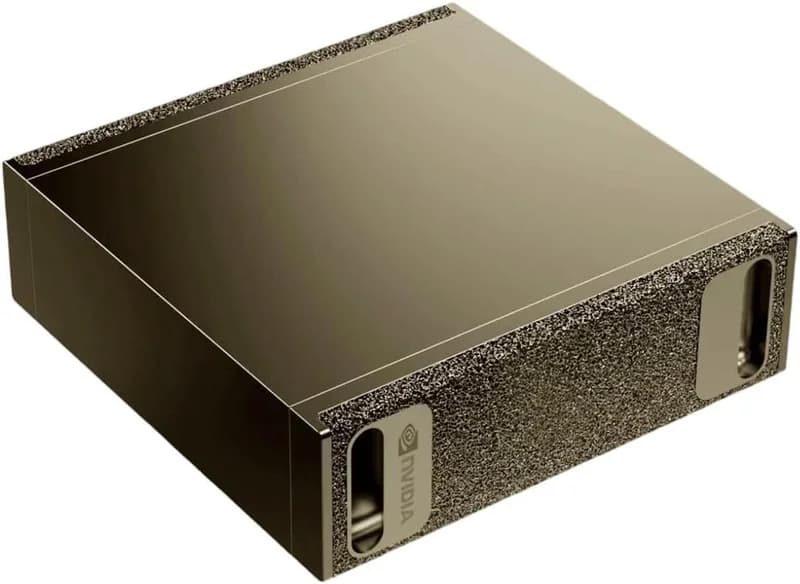
NVIDIA DGX Spark (GB10 Grace Blackwell)
$4,699+
NVIDIA's desktop AI supercomputer, and the CUDA-native answer to the Strix Halo boxes. The GB10 Grace Blackwell superchip pairs a 20-core Arm CPU with a Blackwell GPU and 128GB of coherent unified memory, with a 200GbE ConnectX-7 NIC so two units cluster to run 405B-class models. The headline '1 PFLOP FP4' is sparse — dense compute is roughly half (≈RTX 5070-class) — and at 273 GB/s, memory bandwidth is the real ceiling. You're buying CUDA + capacity, not bandwidth.
Affiliate links — We earn a commission on qualifying purchases at no cost to you.
Specifications
| Chip | GB10 Grace Blackwell Superchip |
| CPU | 20-core Arm (10× Cortex-X925 + 10× A725) |
| GPU | Blackwell (5th-gen Tensor Cores), CUDA-native |
| AI Performance | Up to 1 PFLOP FP4 sparse (~500 TFLOPS dense) |
| Unified Memory | 128GB LPDDR5X |
| Memory Bandwidth | 273 GB/s |
| Networking | ConnectX-7 200GbE (2-unit clustering), 10GbE RJ-45 |
| Storage | 4TB NVMe (self-encrypting) |
| OS | NVIDIA DGX OS (Ubuntu-based) |
Pros
- CUDA-native + full NVIDIA/DGX software stack — best dev ergonomics for AI work
- 128GB unified in a 1.2kg box; 2-unit 200GbE stacking reaches 405B-class locally
- Drop-in compatibility with the datacenter toolchain
Cons
- 273 GB/s bandwidth is low for the price — token throughput lags Apple Ultra and GPUs
- Headline '1 PFLOP FP4' is sparse-only; dense compute ~5070-class, not datacenter-class
- NVIDIA raised the official price from $3,999 to $4,699 (2026-02-27) on memory supply; stock is thin
Related Articles
How Much Context Can a 128GB Mini PC Actually Hold? The KV Cache Math Nobody Runs Before Buying
Everyone sizes a unified-memory box against model weights. Almost nobody sizes it against the KV cache — and on a 128K-token agent run, the cache is the number that decides whether the job finishes. Here's the math, box by box, plus the KV-quantization trade that makes long first prompts slower, not faster.
Can You Fine-Tune an LLM on a 128GB Mini PC? (And Which Box to Buy in 2026)
LoRA and QLoRA on 20–30B models are practical on 128GB of unified memory; full fine-tunes stop near 12B; dense 70B training doesn't happen on any box in this class. Fine-tuning is the one local-AI workload where the software stack — not memory bandwidth — decides which machine you buy. Here's the capability table, the CUDA tax, and the cloud break-even.
Best Mini PC for a Local Coding Agent in 2026 — Why Prefill, Not Tokens/Sec, Decides Your Box
A coding agent re-sends your whole repo context every single turn, which makes it a prefill-bound workload. That flips the buying logic: ~1,700 tok/s prompt processing on a GB10 box vs ~340 tok/s on Strix Halo, while generation is a near-tie. Here's the per-budget verdict, the memory math, and the boxes to skip — with the caveat that the 2026 DRAM spike has narrowed the price gap to about $1,250.
Can You Cluster Two Mini PCs to Run Bigger Local LLMs? (2026 Reality Check)
AMD published a four-node Framework Desktop cluster running a trillion-parameter model, and two DGX Sparks pool 256GB over a single cable. Here's when a second box actually helps, when it makes things slower, and which mini PC to buy if clustering is on your roadmap.
Related Products
Disclosure: Some links on this page are affiliate links. We may earn a commission if you make a purchase — at no extra cost to you. This helps support our independent reviews.