GMKtec EVO-X2 (Ryzen AI Max+ 395, 128GB) vs Framework Desktop (Ryzen AI Max+ 395, 128GB) for AI
A head-to-head comparison of specs, pricing, and real-world AI performance to help you pick the right hardware.
Disclosure: Some links on this page are affiliate links. We may earn a commission if you make a purchase — at no extra cost to you.
Quick Verdict
The GMKtec EVO-X2 (Ryzen AI Max+ 395, 128GB) is the better performer but costs more. Choose it if you need top-tier AI performance and can justify the price premium. The Framework Desktop (Ryzen AI Max+ 395, 128GB) delivers solid value at a lower price point and is the smarter pick for budget-conscious buyers.
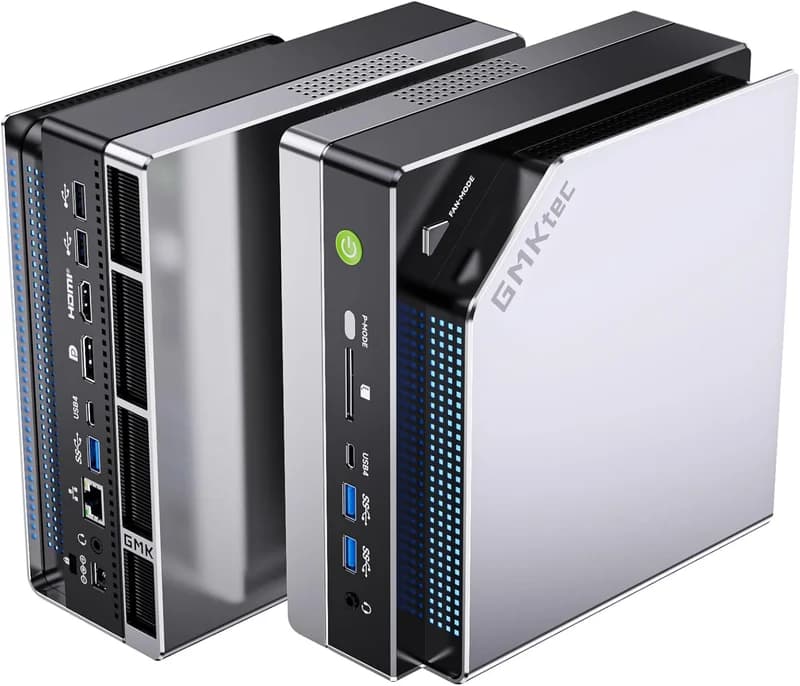
GMKtec EVO-X2 (Ryzen AI Max+ 395, 128GB)
$3,649
The flagship local-AI mini PC. AMD's Ryzen AI Max+ 395 'Strix Halo' pairs a 16-core Zen 5 CPU with a Radeon 8060S iGPU and 128GB of LPDDR5X-8000 unified memory — up to 96GB assignable as VRAM, enough to load 70B-class models that won't fit on any consumer GPU. The catch is bandwidth: ~215 GB/s real, so dense 70B runs at single-digit tokens/sec. Buy it for capacity, not raw speed.
Framework Desktop (Ryzen AI Max+ 395, 128GB)
$3,449
The cheapest credible 128GB box and the best one for tinkerers. Framework drops the Ryzen AI Max+ 395 onto a standard mini-ITX mainboard (it fits any ITX case), with open firmware and the repairability Framework is known for — though, like every Strix Halo box, the memory itself is soldered. Direct-only: no Amazon, so we link to Framework.
Specs Comparison
| Spec | GMKtec EVO-X2 (Ryzen AI Max+ 395, 128GB) | Framework Desktop (Ryzen AI Max+ 395, 128GB) |
|---|---|---|
| Price | $3,649 | $3,449 |
| APU | AMD Ryzen AI Max+ 395 (16C/32T, Zen 5) | AMD Ryzen AI Max+ 395 (16C/32T, Zen 5) |
| GPU | Radeon 8060S (40 CU, RDNA 3.5) | Radeon 8060S (40 CU, RDNA 3.5) |
| NPU | 50 TOPS (XDNA 2) | 50 TOPS (XDNA 2) |
| Unified Memory | 128GB LPDDR5X-8000 (up to 96GB GPU-allocatable) | 128GB LPDDR5X-8000 (up to 96GB GPU-allocatable) |
| Memory Bandwidth | 256 GB/s theoretical (~215 GB/s real) | 256 GB/s theoretical (~215 GB/s real) |
| Storage | 2TB NVMe (dual M.2 2280, up to 16TB) | Dual M.2 NVMe |
| Networking | 2.5GbE, Wi-Fi 7 | — |
| I/O | 2× USB4, HDMI 2.1, DP 1.4 | USB4, 2× front expansion bays |
| Form Factor | — | 4.5L mini-ITX (standard board), Noctua cooler |
GMKtec EVO-X2 (Ryzen AI Max+ 395, 128GB)
Pros
- +128GB unified memory (96GB allocatable) loads 70B-class models no 24–32GB dGPU can hold
- +256-bit LPDDR5X-8000 is ~2× a normal desktop APU — the reason it produces usable tokens/sec
- +Quiet, cool, dual-M.2 expandable — a practical always-on local inference appliance
Cons
- -~215 GB/s is far below a discrete GPU (800–1000 GB/s) — dense 70B is single-digit tok/s
- -Memory is soldered — you must buy the 128GB SKU up front; no upgrade path
- -2.5GbE only (no 10GbE/OCuLink); ROCm/Linux GPU-compute on Strix Halo still rough vs CUDA
Framework Desktop (Ryzen AI Max+ 395, 128GB)
Pros
- +Cheapest credible 128GB box ($1,999)
- +Standard mini-ITX mainboard + open firmware — best Linux/tinkerer story
- +Framework repairability + customizable expansion tiles
Cons
- -Direct-only — not on Amazon
- -Soldered RAM (modularity doesn't extend to memory)
- -iGPU ~RTX 4070-mobile class — not a discrete-GPU replacement
Where to Buy
Related Articles
comparison
DGX Spark 64GB vs Strix Halo 128GB: NVIDIA's $4,999 Spark Has Half the Memory — Should You Buy It?
On October 2 NVIDIA launched a 64GB DGX Spark at $4,999 and moved the 128GB Spark to $6,950. Every 128GB Strix Halo box in our catalog costs less than the new entry Spark. Here's the price-per-GB math, what actually fits in 64GB, and who should still pay for CUDA.
comparison
Mac Studio M5 Max vs Strix Halo: What Apple's September 2026 Refresh Changes for Local LLMs
Apple's M5 Max hits 614 GB/s — roughly 2.9× a Strix Halo box. But the $2,499 headline is a 36GB machine, and getting to 128GB runs a +$600 / +$400 / +$2,000 memory ladder. Here's the arithmetic, including the half that says buy the Mac.
comparison
RTX Spark vs Strix Halo: Buy a 128GB Box Now, or Wait for NVIDIA's October Launch?
NVIDIA's RTX Spark (N1X) ships in October with up to 128GB of unified memory — and NVIDIA's own porting guide puts it at 300 GB/s, not the 600 GB/s everyone is quoting. Here's what that actually changes about the box you buy this week.